Skip to content
AI Engines logo

About AI Engines

We learn it, test it, use it, then teach it.

AI Engines is a veteran-owned company. At AI Engines, our goal is to teach people to use these powerful new tools to enhance the amazing work they already do. We believe that when people are informed, they can not only use AI to do great things but also protect themselves against operators who wish to misuse AI for harmful purposes. We now live at a time in history when what used to be impossible is now possible. Unleash your imagination, wield your experience, and let's make the world a better place by using new tools to give us more time back to be human, create, and dream.

Michael Jones headshot

Veteran-owned · Marion, Indiana

Michael Jones

Founder, lead instructor · Marion, Indiana

I learn it, test it, use it, and teach it, to invest in others and their futures.

Mike Jones, a U.S. Army veteran, is the founder of AI Engines, a veteran-owned company, and the author of the HUMAN-HEART AI Resilience Framework. He served as an M1 Abrams turret mechanic during Desert Storm. His career bridges enterprise technology and education. He has served as Training Lead for international sales at Hewlett Packard (US, India, Spain, and Canada) and as Director of Technology at Schryver Medical, where he led HIPAA-compliant systems across Colorado offices.

At Indiana Wesleyan University he has written courses, taught as adjunct faculty, led ed tech innovations, launched, engineered and co-hosted The Digital2Learn Podcast and a Facebook Fridays live show, produced countless course videos and documentary films, and served as Assistant Director of the National and Global Future Learning Lab. He also helped drive over one million dollars in avoided vendor costs by teaching himself advanced VR tools and C#, then worked with faculty and staff to build virtual reality experiences and gamified learning objects, including a complete VR city with interactive avatars for a gamified Sociology course. He has presented and taught workshops at international and national conferences, most recently OLC 2025.

He has onboarded 250+ faculty and staff to AI, including ethical use and specialized AI bot builds. He is a Level 3 Certified AI Agent Developer through MindStudio, the highest tier of that program, with the build credentials to ship the same kind of agents he teaches participants to design. He holds an MFA in Screenwriting from Asbury University, a BS in Business Information Systems from Indiana Wesleyan University, and a Steadicam Operator certification. He was awarded the Louisiana War Cross and three Army Achievement Medals. He lives in Marion, Indiana.

His work is pedagogically sound, bridge-building by design, and built on a simple rule: AI must strengthen the human it serves, not replace them.

James Weaver headshot

James Weaver

Co-trainer for groups of 13 or more, developer advocate · Greater Indianapolis

Java Champion, JavaOne Rockstar, Quantum Developer Advocate.

James is a Java Champion, a JavaOne Rockstar, and a Quantum Developer Advocate. He is the author of Inside Java, Beginning J2EE, the Pro JavaFX series, and Java with Raspberry Pi. He has taught thousands of developers at conferences around the world and brings enterprise-scale credibility to the AI Engines curriculum.

When James joins a training as co-trainer, he translates advanced ideas into working examples. Teachers, pastors, and small-business owners leave with the same clarity he gives senior engineers.

Proud 2026 investor member of the Greater Grant County Chamber of Commerce.

The HUMAN-HEART framework

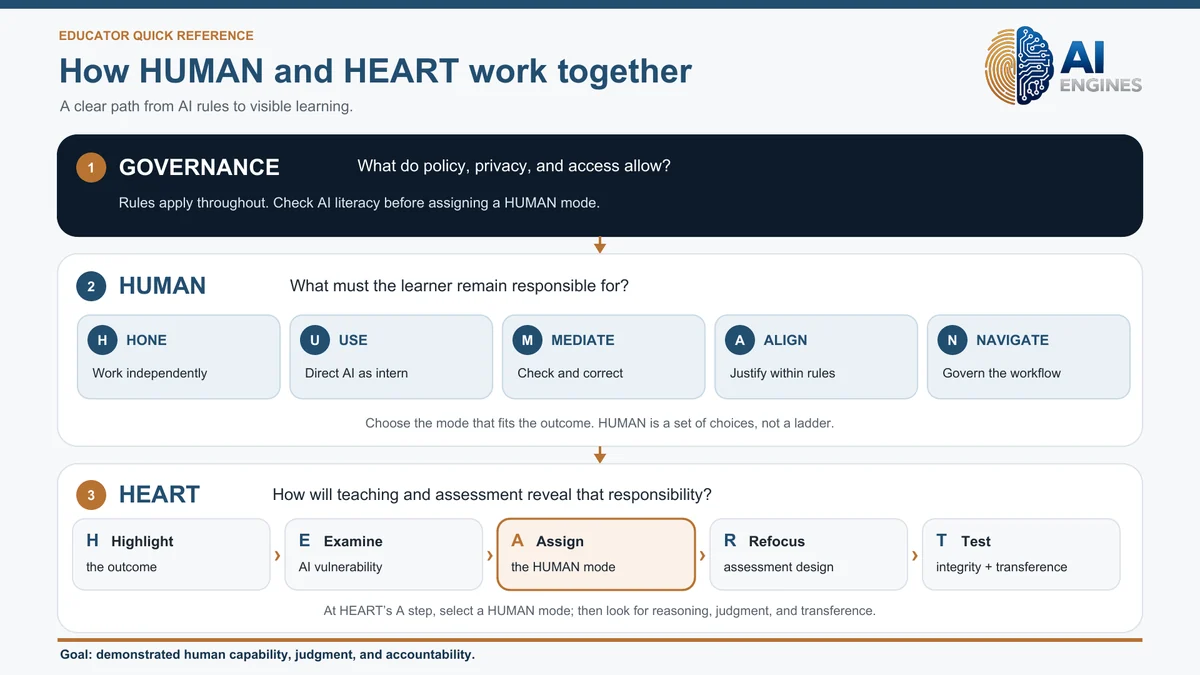
HUMAN-HEART is Mike's instructional design framework for AI-resilient teaching. It starts with governance: what policy, privacy, and access allow. Those rules apply throughout, and learners' AI literacy is checked before a HUMAN mode is assigned. HUMAN then asks what the learner must remain responsible for, with five modes: Hone (work independently), Use (direct AI as an intern), Mediate (check and correct), Align (justify within rules), and Navigate (govern the workflow). HUMAN is a set of choices, not a ladder. You choose the mode that fits the outcome. HEART asks how teaching and assessment will reveal that responsibility: highlight the outcome, examine AI vulnerability, assign the HUMAN mode, refocus assessment design, and test for integrity and transference. We do not set the regulatory floor for your context. We help you recognize the one your institution already operates under and design around it. The goal is demonstrated human capability, judgment, and accountability, in courses and assignments where AI reinforces academic integrity rather than eroding it.

AI Engines HUMAN/HEART educator quick reference: Governance first, then the five HUMAN modes for what the learner stays responsible for, then the five HEART steps that make it visible in teaching and assessment.
How HUMAN and HEART work together: an educator quick reference.
Text version

Educator quick reference

How HUMAN and HEART work together

A clear path from AI rules to visible learning.

1. Governance: what do policy, privacy, and access allow?

Rules apply throughout. Check AI literacy before assigning a HUMAN mode.

2. HUMAN: what must the learner remain responsible for?

  • Hone: Work independently
  • Use: Direct AI as intern
  • Mediate: Check and correct
  • Align: Justify within rules
  • Navigate: Govern the workflow

Choose the mode that fits the outcome. HUMAN is a set of choices, not a ladder.

3. HEART: how will teaching and assessment reveal that responsibility?

  1. Highlight the outcome
  2. Examine AI vulnerability
  3. Assign the HUMAN mode
  4. Refocus assessment design
  5. Test integrity + transference

At HEART's A step, select a HUMAN mode; then look for reasoning, judgment, and transference.

Goal: demonstrated human capability, judgment, and accountability.

The HUMAN-HEART framework is purpose-built for education contexts. It runs as a separate, custom engagement, not as part of the AI Foundations workshop. See the services page to start a conversation about a HUMAN-HEART engagement for your school, department, or district.